

Short answer
In Yucatan, paid real estate intermediation is subject to a state licensing and registry system administered by the Institute for Patrimonial Legal Security of Yucatan (INSEJUPY). The law covers advising, promoting, marketing, and leasing real estate, in person or digitally, when someone intermediates between an owner and a third party. Advisers and agencies within that definition must hold the applicable license and appear in the State Registry. The governing framework is in the law that created INSEJUPY, not in Decree 73/2025 alone.
The practical recommendation is firm: before sharing documents, transferring money, or signing, check the official public State Registry and use a professional with a current license. This provides verifiable identity, duties defined by law, and an official accountability route. It does not replace notarial, legal, registry, tax, technical, title, or property-condition due diligence.
Key facts
- Authority: INSEJUPY.
- Official registry: State Registry of Real Estate Advisers.
- License types: Type A for a certified individual adviser, Type B for a certified agency, and Type C for affiliated personnel training under an agency.
- Legal milestones: original law published July 19, 2011; real estate reform published July 31, 2024; operating regulation amended May 21, 2025; notarial form and guide published in June 2026.
- Scope: sale, lease, and other ownership, use, or usufruct transactions listed in Article 4(XIV) of the consolidated law.
- Consumer recommendation: verify the name, type, number, and validity through the official source; do not confuse platform enrollment, training, membership, or a competency certificate with an issued state license.
Implementation snapshot dated July 6, 2026. An official Yucatan government release reported 1,272 people enrolled on the platform, 638 who had completed the first ten hours taught by INSEJUPY, and 130 holding the document accrediting them to provide intermediation under the legislation. The first two figures are not issued-license counts, and ten hours are not the fifty hours required for an initial Type A registration.
Public-registry snapshot for Valladolid
Use the official public registry and search BAÑUELOS. Match each advisor’s full legal name, individual folio, license type, issue date, and validity date; do not transfer one person’s record to another.
Timeline: 2011, 2024, 2025, and 2026
- July 19, 2011: the law creating INSEJUPY was published. The later real estate framework should not be presented as the Institute's origin. Read the consolidated law.
- July 31, 2024: Decree 804/2024 added the State Registry, license, rights-and-duties chapters and Articles 237-243 on real estate infractions and sanctions to the law.
- May 21, 2025: Decree 73/2025 amended the Regulation and added Title Five Bis, Articles 198 Bis through 198 Sexdecies, to operate the registry, platform, training, and filing procedures.
- June 26, 2026: Agreement INSEJUPY 02/2026 issued the notarial form and announced the guide. The official guide set the initial rollout for the bimonthly-report and immediate-notice modules.
The law and Decree 73/2025 are not the same
The law that created INSEJUPY contains the principal legal architecture: the definition of intermediation, the State Registry, license types, requirements and validity, adviser and agency duties, notarial reporting, and sanctions. Decree 804/2024 inserted the material real estate framework into that law. Consolidated law.
Decree 73/2025 did not create or amend that parent law. It amended the implementing Regulation to establish operating rules for the digital platform, applications, documents, advanced electronic signatures, biometric identification, and in-person comparison of originals, among other procedures. Decree 73/2025 and consolidated Regulation. It is therefore inaccurate to cite the 2025 decree as the complete licensing law.
What is INSEJUPY?
INSEJUPY administers the state system, and its Directorate General maintains the Registry. Articles 123 Bis and 123 Sexies of the law define the State Registry as the official, systematic, publicly accessible roster of people and entities that obtained Type A, B, or C licenses. The law also requires it to record grants, expiration, revocation, pending complaints or proceedings, and sanctions; that describes what the Registry must contain, not a promise that every field appears in every public view.
Article 198 Quinquies of the Regulation requires the roster to be public and searchable through the Institute's website. Its practical value is that anyone can compare an intermediary's claimed identity and status with a government source. Registry presence does not guarantee title, property condition, successful closing, or freedom from fraud.
Who needs a license and who is excluded?
Article 4(XIV) of the law defines real estate intermediation as paid professional activity, in person, electronically, or digitally, to advise on, promote, market, or lease real estate between an owner and a third party. It includes activity directed toward sales, leases, donations, mortgage-secured loans, transfers, trusts, settlements, adjudications, assignments, and other contracts transferring ownership, use, or usufruct.
Read with that definition and its exclusions, Articles 123 Octies and 123 Quinquies reserve those services and related self-promotion to advisers and agencies with the applicable license and registration. The exclusions are narrow:
- Public notaries, public brokers, and appraisers only when acting within their official functions.
- Subordinate sales or marketing personnel only when working exclusively in developments owned by the developer.
- Licensed legal professionals only when their sole function is to provide legal and patrimonial certainty to their clients.
An activity-specific exclusion is not a blanket exemption to provide intermediation. When a working model is uncertain, confirm the exact situation with INSEJUPY before operating or hiring.
Type A, Type B, and Type C licenses
Article 123 Nonies of the law establishes three distinct categories. They do not have the same holder, requirements, or validity.
Type A: Certified Real Estate Adviser (Articles 123 Decies and 123 Sexdecies)
- Holder: an individual who provides real estate advice or intermediation.
- Application package: current official ID; tax registration in the applicable regime; fiscal and conventional addresses; a labor-competency certificate issued by a certification and evaluation entity authorized by CONOCER; a sworn consumer-law and standards declaration; evidence of PROFECO registration of the adhesion contract; annual-program commitments; and, for foreign applicants, immigration documents showing current work authorization and lawful residence.
- Training: initial registration requires 50 hours. For renewal, Article 123 Decies says 30 hours in the final year of validity, while Article 123 Sexdecies says 30 hours in the calendar year immediately preceding the application. Because the wording is not identical, confirm the applicable operating period with INSEJUPY.
- Validity: five years, subject to renewal requirements.
- Trade name: an individual operating under a commercial brand must also request Type B, but that fact alone does not require forming a legal entity.
Type B: Certified Real Estate Agency (Articles 123 Undecies, 123 Duodecies, and 123 Septendecies)
- Holder: a legal entity providing intermediation; it is also the additional license specified for an individual operating under a commercial brand.
- Structure: for a legal entity, at least one partner or shareholder and also the legal representative must have current Type A status and active registration. All advisers must hold Type A or Type C, as applicable.
- Application package: identification and authority documents, formation documents where applicable, addresses and branches, consumer compliance and PROFECO-registered adhesion contract, current tax evidence, personnel competency, and the list of associated advisers.
- Validity: six years. A legal entity's renewal updates the original information and proves 30 calendar-year training hours for Type C personnel; an individual must renew Type A first.
Type C: Affiliated Real Estate Adviser (Articles 123 Terdecies and 123 Octodecies)
- Holder: personnel in training for whom an agency requests the license.
- Relationship: the person must have a legal relationship with the agency and act in its name and representation.
- Responsibility: the agency assumes the responsibility specified by law for its Type C personnel and for intentional or negligent third-party harm caused within that representation.
- Validity: one year and nonrenewable. The responsible agency may request an extension, distinct from renewal, of up to twelve months; once it expires, the license is cancelled and cannot be reissued in the same modality.
A course, professional membership, PROFECO record, or competency certificate may be part of a person's preparation or application file, but it is not by itself the Type A, B, or C state license.
What a licensed adviser must do
Article 123 Novodecies of the law turns a license into verifiable obligations, not a marketing badge. They include:
- Displaying the license number, issuing authority, and validity in advertising, websites, service contracts, and administrative documents.
- Obtaining written authority from the lawful owner or a person legally authorized to market before promoting a property, and performing the owner/property check specified by law before publication.
- Attending INSEJUPY updating and training programs.
- Retaining service-generated documents for five years from issuance and facilitating reviews of services provided during the preceding five years.
- Responding to INSEJUPY information requests, verification visits, and collaboration proceedings related to intermediation functions.
- Disclosing participation and license details in covered notarized instruments.
- Acting with honesty, efficiency, transparency, rectitude, and ethics; safeguarding the interests identified by law and avoiding discrimination under the applicable legal terms.
These duties create verification and discipline points. They do not turn an adviser into a notary, lawyer, appraiser, tax professional, or property guarantor, and they do not assure an outcome.
Fines and sanctions for violations
UMA is an indexed legal unit whose peso value changes annually. To avoid a conversion that becomes stale, the following are the statutory formulas, not peso equivalents. Articles 237-243 of the law distinguish the conduct and consequences:
Article 237: properties or developments without approvals, or other violations within its predicate. It applies to advisers or agencies intermediating properties or developments without the corresponding authorizations and licenses, or violating the law or Regulation while providing intermediation. For those predicates it provides a fine from 50 through 2,000 UMA. If the services aim at an onerous transaction, it sets a calculation of 1%-5% of value, capped at twice the fees charged.
Article 238: violating the law or duties while providing intermediation. It may involve a fine from 50 through 2,000 UMA. When services aim at an onerous transaction, it uses the 1%-5% calculation with a cap of twice the fees. It also provides for suspension of 30-360 days or revocation. Listing those consequences does not mean all of them are imposed together.
Article 239: holding oneself out or attempting to act without a license and providing intermediation. A person or entity must meet both parts of the predicate: holding itself out, identifying itself, or attempting to act as an adviser or agency without the required license and providing intermediation. The fine is 100-2,000 UMA; the lower limit applies to a first infringement. If that intermediation aims at an onerous transaction, the article establishes 1%-5% of value, capped at twice the fees. The provision sanctions the intermediary within its predicate, not the consumer automatically.
Article 240: enabling or simulating licensed status. It applies to an adviser or agency that knows another person lacks a license and enables that person to act as though licensed, or simulates acts to deceive or keep users mistaken about that status. It provides 100-1,000 UMA or suspension according to seriousness and repeat-offender status.
The percentages, caps, fines, suspension, and revocation are not automatically cumulative, and the maximum is not automatic. Article 242 requires INSEJUPY to state the legal and factual reasons for a sanction and consider seriousness, intent, actual or possible harm, and repeat-offender status. Article 241 preserves potential liability for intentional or negligent harm and applicable civil or criminal responsibility, each requiring its own evidence and process.
What the notary must do
For a public deed conveying real estate located in Yucatan, Article 123 Quater of the law requires the notary to collect information from the parties about any adviser or agency involved. The parties make a declaration under oath to tell the truth on the official form; the notary collects it, but this party declaration is not a notarial warranty of the intermediary.
The form requests license type and number, name, phone, email, website, and how the party found the services. It also permits the party to identify a person who lacks a license. The list of forms and signed originals are sent to the Institute during the first ten days of even-numbered months under the bimonthly schedule in the official guide.
There is a separate duty: when the notary detects that the person who provided intermediation lacks a current Type A, B, or C license, the notary must notify the Institute, document the notice, and do so within fifteen business days after the transaction is signed. That immediate notice is independent of the bimonthly batch.
In the 2026 operating process, the guide separates two modules:
- Bimonthly Report: transactions in which the parties stated that a currently licensed adviser or agency participated; the transaction is recorded and submitted in the relevant reporting window.
- Immediate Notice: transactions in which unlicensed intermediation was reported; each is recorded individually within the fifteen-business-day period.
The first report covers July-August 2026 and is due October 1-10, 2026. Only for that first period, July is optional and August is mandatory. This is a one-time 2026 rollout rule, not an original provision of the 2025 decree.
What notarial reporting does not mean
The reviewed law and operating documents do not establish that a notary must refuse to execute a deed solely because an unlicensed intermediary participated. They also do not establish that such participation invalidates the sale or deed by itself, or that a buyer or seller receives a fine merely for using that person.
The system creates a documented reporting and enforcement route. It does not turn signing before a notary into early adviser verification, and it does not by itself recover money or documents already transferred. The sound practice remains to search the State Registry before proceeding.
Why using a professional with a current license matters
The reason is not that a license guarantees a flawless transaction. It is that it lets a consumer verify three useful things:
- Identity and status: name, license type, and number can be checked against the official roster.
- Defined duties: identified advertising, written authority to market, training, document retention, cooperation with verification, and disclosure before a notary.
- Accountability route: complaints, proceedings, and sanctions are part of the legal and registry system; a person without a license lacks a current license that can be verified and the same license-based duties and discipline path, while remaining subject to unlicensed-intermediation sanctions and other applicable liability.
That is why we recommend verifying and using a professional with a current license. This supplements, rather than replaces, complete due diligence: a notary, independent legal advice when appropriate, title and registry history, tax status, boundaries and measurements, land use, permits, technical inspection, and physical property condition.
How to verify a license in the public registry
- Open the State Registry of Real Estate Advisers on INSEJUPY's official domain.
- Search the full name of the person or agency. Do not rely solely on a screenshot sent through a messaging app.
- Compare the name, license type, and complete number with the advertising, contract, and documents you received.
- Review validity and any grant, expiration, revocation, complaint, proceeding, or sanction information shown in the official view.
- If the registry does not load, no exact match appears, or details differ, pause the transaction and ask INSEJUPY for clarification. An issued document or an older screenshot does not by itself establish current status.
- Repeat the search before transferring a material amount or signing. Keep the date, URL, and evidence of your check.
For a step-by-step walkthrough, use our guide to verifying a real estate adviser.
AMPI, NAR and REALTOR are separate checks
After confirming the Yucatán state license in INSEJUPY, verify any AMPI, NAR or REALTOR claim separately. Association membership can be a useful professional signal, but it is not the state license and old logos can remain online after a membership stops being active. The AMPI and NAR / REALTOR verification guide explains how to check the public sources.
Verifiable examples: Diana and Dalila De León
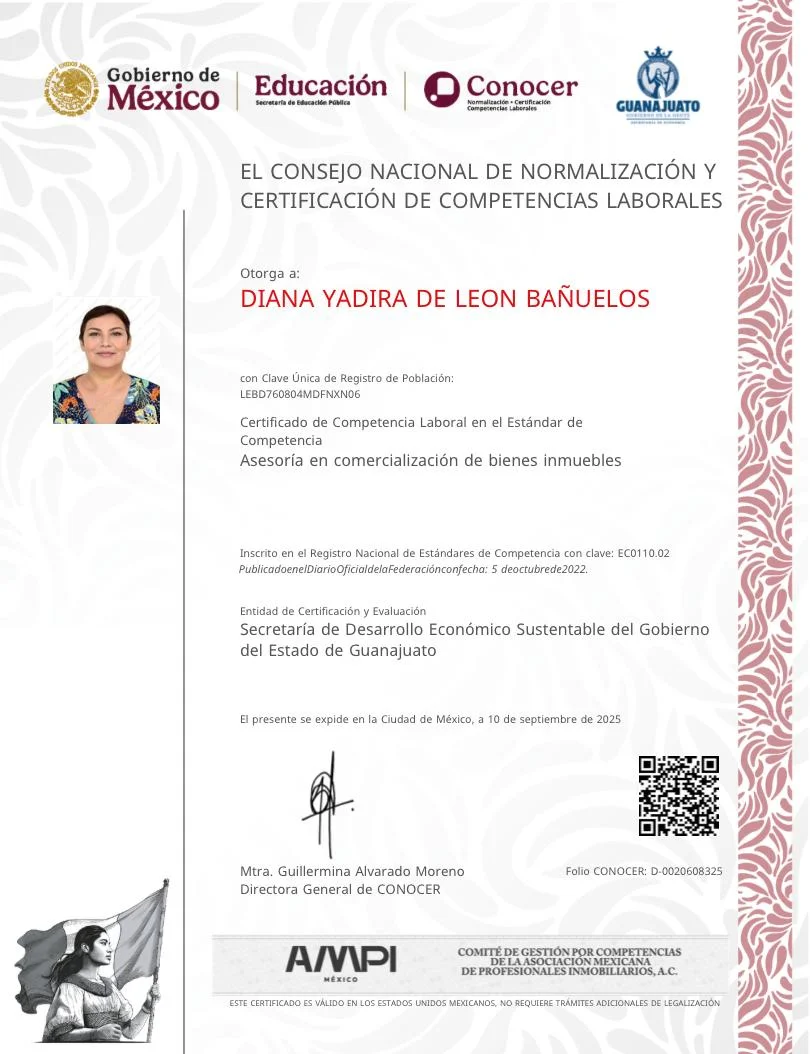
Casas en Valladolid publishes independent INSEJUPY Tipo A records for Diana Yadira de León Bañuelos — REAI-INSEJUPY-A-00194 and Dalila Yesenia de León Bañuelos — REAI-INSEJUPY-A-00030. In the official registry, search BAÑUELOS and match the full legal name, folio, license type, and validity dates.
The public registry result does not replace a new lookup before a transaction. Registry pages can change, availability can vary, and buyers should still search BAÑUELOS, match the full legal name and individual folio, and verify current validity directly with INSEJUPY before signing or transferring money.
The Casas en Valladolid credentials present the same five core proof groups for Diana and Dalila side by side; Dalila has the additional NAR membership record.
Checklist for buyers, sellers, landlords, and tenants
- Search both the adviser and, where applicable, the agency in the State Registry.
- Compare the name, Type A/B/C, complete number, issuing authority, and validity.
- Ask for those details to appear in advertising, the service contract, and administrative documents.
- Confirm who represents whom, the fee, when it is earned, and how advances or deposits are handled.
- When a property is being promoted, request evidence of written authority from the person entitled to market it.
- Separately verify owner identity, title, liens, dimensions, boundaries, use, permits, taxes, services, and physical condition.
- Do not transfer funds to an unverified account or sign blank documents or documents you do not understand.
- Use the notary and, when risk warrants it, an independent lawyer, appraiser, tax professional, or technical expert.
- Repeat the license lookup before payment or signature and retain dated evidence.
- If details conflict, stop that step and contact INSEJUPY and the independent professional handling your transaction.
Frequently asked questions
How do I find Diana and Dalila in the public registry?
Search BAÑUELOS and separately match Diana Yadira de León Bañuelos to REAI-INSEJUPY-A-00194 and Dalila Yesenia de León Bañuelos to REAI-INSEJUPY-A-00030.
Is a real estate license mandatory in Yucatan?
For a person within the legal definition of paid intermediation who does not fit an exclusion, Articles 123 Octies and 123 Quinquies require the applicable license and registration. Review the complete predicate in the consolidated law.
Does the law also cover rentals?
Yes. The definition includes advising, promoting, marketing, or leasing and lists ownership, use, and usufruct transactions. It is not limited to sales.
Are Type A, B, and C licenses equivalent?
No. Type A is for a certified individual adviser, Type B for a certified agency or the additional trade-name situation, and Type C for personnel in training linked to and represented by an agency. Their requirements and validity differ.
How many hours does an initial Type A license require?
Article 123 Decies requires 50 hours for initial registration. For renewal, two articles use different time formulations for the 30 hours; confirm with INSEJUPY whether a filing uses the final validity year or the calendar year immediately preceding the application.
How long is each license valid?
Type A is valid for five years; Type B, six; Type C, one year and nonrenewable. For Type C, the agency may request a separate extension of up to twelve months.
Does a CONOCER certificate, course, or professional membership replace the license?
No. A certificate issued by a CONOCER-authorized entity may be an application requirement, and training or membership may show preparation. None is the state license itself or proof that it remains current.
Must the license number appear in advertising?
Yes. Article 123 Novodecies requires licensed advisers and agencies to display the number, issuing authority, and validity in advertising, websites, service contracts, and administrative documents.
What sanction applies to unlicensed intermediation?
Article 239 applies when a person or entity holds itself out, identifies itself, or attempts to act without a license and provides intermediation. It provides 100-2,000 UMA, with the lower limit for a first infringement; for an onerous transaction it includes 1%-5% of value capped at twice the fees.
Is the maximum fine automatic, or are all sanctions added together?
No. The articles have different predicates and consequences. Article 242 requires a reasoned decision considering seriousness, intent, harm, and repeat-offender status. A list of sanctions does not establish automatic, simultaneous, or maximum application.
Must a notary refuse the deed if an unlicensed intermediary participated?
The reviewed sources do not create a refusal rule based on that fact alone. They require a party declaration, reporting, and, when unlicensed intermediation is detected, notice to INSEJUPY within fifteen business days.
Does using an unlicensed person invalidate the transaction by itself?
That consequence does not follow from the reviewed provisions. Nor do they create an automatic consumer fine. A notary or lawyer should analyze the facts and documents of a specific case.
What is reported in 2026, and when?
The bimonthly module records transactions reported with a currently licensed intermediary; immediate notice individually records those reported with unlicensed intermediation. The first batch covers July-August 2026, is due October 1-10, and exceptionally makes July optional and August mandatory. Official guide.
Does a current license guarantee the property and transaction are sound?
No. It provides verifiable identity, duties, and an official accountability route. It must be combined with notarial, legal, registry, tax, technical, title, and property-condition review.
How should I verify the Casas examples?
Search BAÑUELOS in the State Registry, then match Diana to REAI-INSEJUPY-A-00194 and Dalila to REAI-INSEJUPY-A-00030. Check each full legal name and current validity; printed or previously displayed dates do not replace a live lookup.
This English explanation is general information, not legal advice or an official translation. The official Spanish legal text controls. Confirm current requirements with INSEJUPY and the notary or licensed attorney handling your transaction.
Official sources
- Law Creating the Institute for Patrimonial Legal Security of Yucatan, consolidated Spanish text.
- Decree 804/2024, Official Gazette of July 31, 2024.
- Decree 73/2025, Official Gazette of May 21, 2025.
- Regulation of the Law Creating INSEJUPY, consolidated Spanish text.
- State Registry of Real Estate Advisers.
- Official form for notaries.
- Guide for notarial information reporting.
- Agreement INSEJUPY 02/2026, Official Gazette of June 26, 2026.
- Yucatan government release dated July 6, 2026.